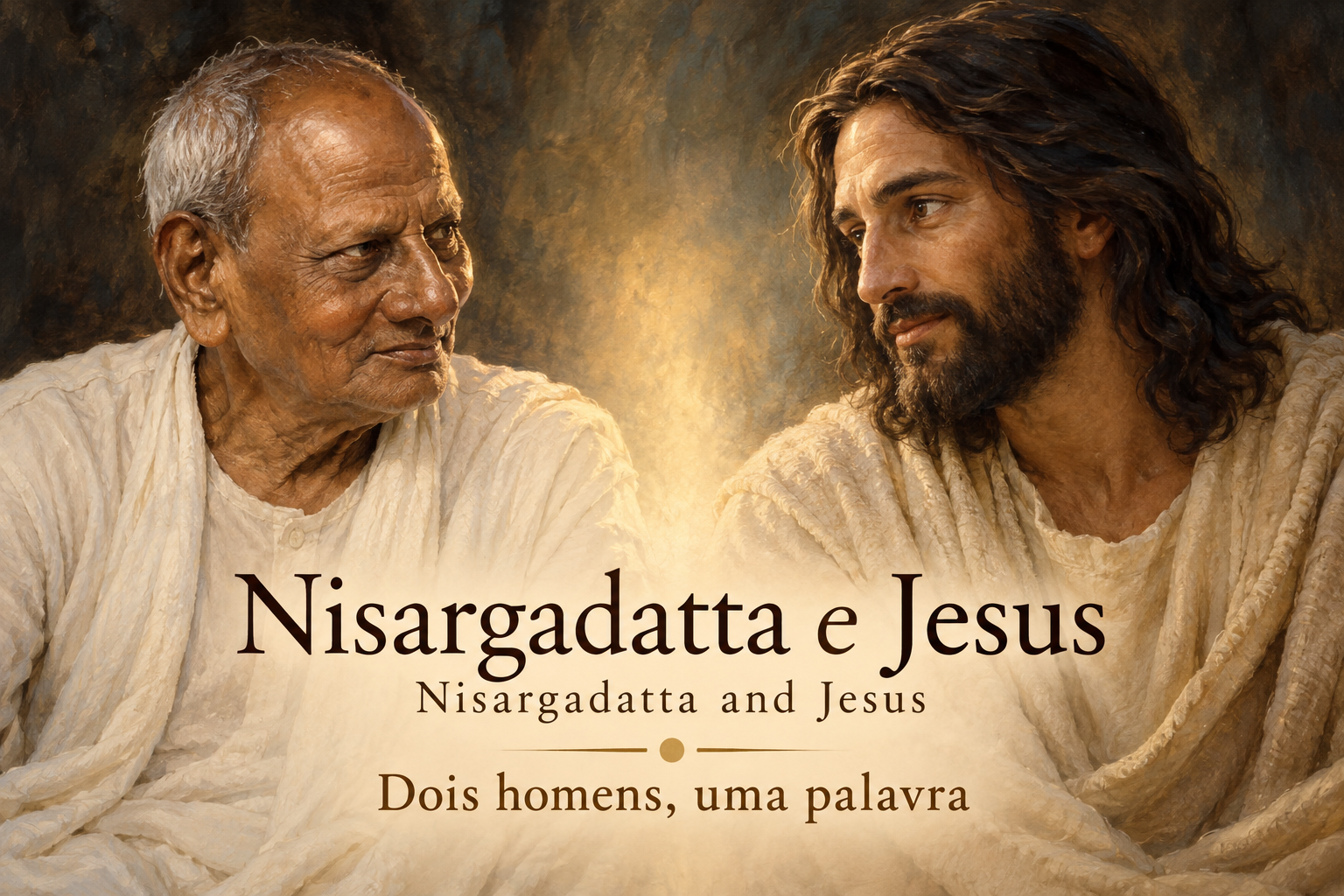
One sold cigarettes in a narrow lane in Bombay. The other was a carpenter in a village in Galilee. Nineteen centuries lie between them, along with different languages and worlds that never touched.
Sri Nisargadatta Maharaj (1897–1981) was an Indian teacher of Advaita, a word meaning “not-two”: the idea that, at bottom, there is only one reality. Jesus of Nazareth never spoke of Advaita. He spoke of the Father, the Kingdom, and love.
And yet both pointed to the same simple thing, so close that hardly anyone notices it: the fact of being. The two shortest words in any language. I am.
This piece does not claim the two taught the same doctrine. It only places them side by side to see what happens when each one sheds light on the other.
“Before Abraham was, I am”
In the Gospel of John, Jesus says something that shocked his listeners: “Before Abraham was, I am” (John 8:58). He does not say “I was.” He says “I am,” in the present tense, as if speaking of something outside time.
The words echo God’s answer to Moses at the burning bush: “I AM THAT I AM” (Exodus 3:14). They echo the Psalm as well: “Be still, and know that I am God” (Psalm 46:10).
Nisargadatta reached the same point by another road. His teacher gave him a single instruction: stay with the sense “I am.” Not “I am so-and-so,” not “I am this or that.” Just the bare feeling of existing, before any thought. He followed it for about three years, and that was enough.
Read together, each lights up the other. Jesus’ “I am” is not the name of the man from Nazareth. It is what already was before Abraham, before time. And Nisargadatta’s “I am” is not the cigarette seller. It is what is present in anyone who says, silently: I exist.
The Father and the Absolute
For Nisargadatta, “I am” is not yet the end of the journey. It is the door. Before “I am” there is the Absolute, which he called Parabrahman (“that which is beyond everything”): what does not even need to know that it exists. “I am” arises from it, and through it returns to it.
Jesus speaks in a strikingly similar way. He says “I am the door” (John 10:9). He says “I and my Father are one” (John 10:30). And he also says “my Father is greater than I” (John 14:28).
These sayings seem to contradict each other until you read Nisargadatta. “I am” is one with the Source, and at the same time it points beyond itself, to something greater and prior. In that light one can read, contemplatively, another saying: “No man cometh unto the Father, but by me” (John 14:6). No one reaches the Source except by passing through the simple “I am.”
Losing life to find it
“Whosoever will lose his life for my sake shall find it” (Matthew 16:25). And again: “Except a corn of wheat fall into the ground and die, it abideth alone: but if it die, it bringeth forth much fruit” (John 12:24).
Nisargadatta would say that what dies is not you. It is the idea of being a separate person, tied to a body, with a story that begins at birth and ends in the grave. He insisted that what we really are was never born, and so cannot die.
Both speak of the same death: the death of the false, not of the true. The grain loses its husk. What was inside was alive all along.
Love as the bridge
Nisargadatta left a saying many people treasure: wisdom shows that I am nothing; love shows that I am everything; and between the two, life flows. He did not choose between emptiness and love. He kept both.
Jesus summed up the whole Law as loving God and loving “thy neighbour as thyself” (Matthew 22:39). Read in the light of “I am,” the words “as thyself” take on a new meaning. If the same “I am” lives in me and in you, my neighbor is not someone else. It is the same being, looking out through other eyes. And “the kingdom of God is within you” (Luke 17:21) because there is nowhere else for it to be.
In practice, both ask almost the same thing:
- Sit quietly for a few minutes and feel “I am,” adding nothing to it.
- Notice that this “I am” has no age, no name, no story.
- When you meet another person, remember that the same “I am” is there too.
A cigarette seller and a carpenter. Neither was a theologian. Both simply looked at what was nearest, and found eternity there.
Deixe uma resposta