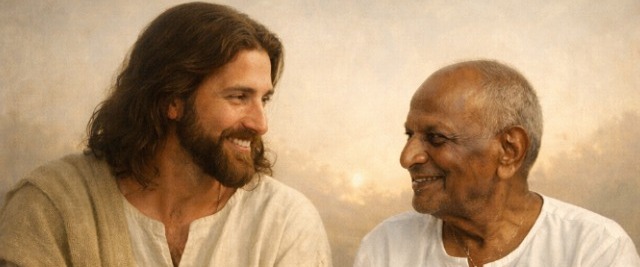
A imbricação entre Nisargadatta Maharaj e Jesus, lida à luz de Um Curso em Milagres, não está na forma externa das tradições, mas no núcleo vivo de seus ensinamentos: a libertação da falsa identidade.
Nisargadatta aponta diretamente para aquilo que antecede o corpo, a mente, a história pessoal e até mesmo o sentido individual de “eu sou”. Para ele, o sofrimento nasce da identificação com o personagem: este corpo, este nome, esta biografia, este conjunto de desejos, medos e memórias. O caminho é voltar-se para a fonte da consciência, reconhecer o “eu sou” puro e, finalmente, ir além dele, no Absoluto sem forma.
Jesus, em Um Curso em Milagres, ensina a mesma libertação em linguagem de perdão. O ego é a crença na separação. O mundo percebido pelo ego é projeção da culpa, do medo e da ideia de que nos apartamos de Deus. A cura acontece quando a percepção é entregue ao Espírito Santo, que desfaz a interpretação equivocada e nos conduz ao reconhecimento de que a separação jamais ocorreu.
Assim, Nisargadatta e Jesus se encontram no ponto essencial: o “eu” que sofre não é real. O corpo não é a nossa identidade. A mente condicionada não é a verdade. A história pessoal não define o Ser. O que somos permanece intocado, anterior ao nascimento, imune à morte e livre de toda culpa.
Nisargadatta diz: investigue quem é você antes de qualquer conceito. Jesus, no UCEM, diz: perdoe o mundo que você fabricou e reconheça a inocência do Filho de Deus. Um fala pela via da investigação radical; o outro, pela via do perdão e da correção da percepção. Mas ambos desfazem o mesmo erro: a crença de que somos entidades separadas, vulneráveis e culpadas.
A imbricação entre esses dois ensinamentos revela uma ponte profunda: o Absoluto de Nisargadatta e o Deus de Jesus não são objetos de crença, mas a Realidade única, anterior ao sonho da separação. O despertar não é tornar o personagem mais espiritual, mas reconhecer que o personagem jamais foi o que somos.
No fim, tanto Nisargadatta quanto Jesus nos chamam ao mesmo silêncio: abandonar a falsa centralidade do ego e repousar na Verdade que nunca foi perdida.
The connection between Nisargadatta Maharaj and Jesus, viewed through the lens of A Course in Miracles, lies not in the external forms of their traditions, but in the living core of their teachings: liberation from false identity.
Nisargadatta points directly to that which precedes the body, the mind, personal history, and even the individual sense of “I am.” For him, suffering arises from identification with the character: this body, this name, this biography, this set of desires, fears, and memories. The path is to turn toward the source of consciousness, recognize the pure “I am,” and, finally, go beyond it, into the formless Absolute.
Jesus, in A Course in Miracles, teaches the same liberation in the language of forgiveness. The ego is the belief in separation. The world perceived by the ego is a projection of guilt, fear, and the idea that we are separated from God. Healing occurs when perception is surrendered to the Holy Spirit, who undoes the mistaken interpretation and leads us to the recognition that separation never occurred.
Thus, Nisargadatta and Jesus meet at the essential point: the “I” that suffers is not real. The body is not our identity. The conditioned mind is not the truth. Personal history does not define the Self. What we are remains untouched, prior to birth, immune to death, and free from all guilt.
Nisargadatta says: investigate who you are before any concept. Jesus, in UCEM, says: forgive the world you have fabricated and recognize the innocence of the Son of God. One speaks through the path of radical inquiry; the other, through the path of forgiveness and the correction of perception. But both dispel the same error: the belief that we are separate, vulnerable, and guilty entities.
The interweaving of these two teachings reveals a profound bridge: Nisargadatta’s Absolute and Jesus’ God are not objects of belief, but the single Reality, prior to the dream of separation. Awakening is not about making the character more spiritual, but recognizing that the character was never who we are.
In the end, both Nisargadatta and Jesus call us to the same silence: to abandon the false centrality of the ego and rest in the Truth that was never lost.
Deixe uma resposta