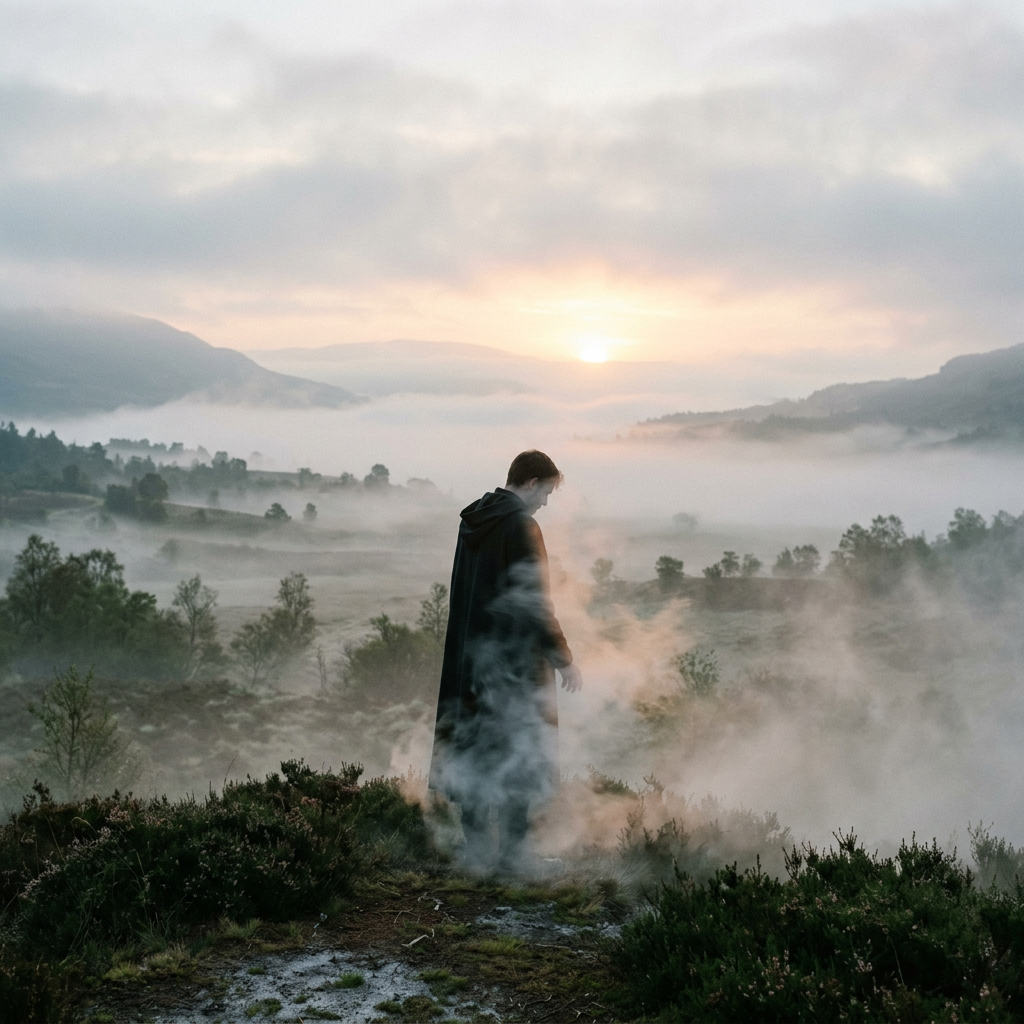
• Antes do silêncio, o vento

    Antes do silêncio, o vento

    Há momentos em que a vida não ensina por meio de palavras. Ensina por um som, por uma queda, por um vento que atravessa a tarde e, sem pedir licença, interrompe a continuidade do pensamento.

    O silêncio verdadeiro não é algo fabricado. Não nasce de uma técnica, nem de um esforço heroico da mente para calar a si mesma. Quando a mente tenta produzir silêncio, ela apenas cria mais uma forma de ruído: o ruído sutil de alguém tentando ficar quieto.

    Mas às vezes algo acontece.

    Um vento passa.
    Uma árvore cai.
    Uma imagem surge.
    Uma alegria inexplicável aparece.
    E, por um instante, o mundo deixa de ser um problema a resolver.

    Nesse instante, não há filosofia. Não há doutrina. Não há sequer alguém meditando. Há apenas a presença nua do que é.

    Nisargadatta dizia que aquilo que percebe não pertence ao percebido. O corpo, o mundo, os pensamentos, as emoções — tudo isso aparece e desaparece. Mas há algo que não aparece como objeto. Algo que não pode ser visto, porque é aquilo pelo qual toda visão é possível.

    Esse “algo” não é uma coisa. Não é uma alma individual escondida atrás dos olhos. Não é uma pessoa mais profunda. É anterior ao nome, anterior à história, anterior até mesmo à ideia de “eu sou alguém”.

    O drama humano começa quando a consciência se confunde com sua própria manifestação. O pensamento surge e diz: “sou eu”. A emoção surge e diz: “isto é meu”. O corpo envelhece e dizemos: “estou acabando”. Mas tudo isso pertence ao campo do que é visto.

    O vento, quando vem, pode rasgar essa hipnose.

    Por um segundo, compreende-se sem palavras: eu não sou aquilo que passa. Eu sou o espaço no qual tudo passa. E mesmo essa frase ainda diz demais, porque onde há espaço, ainda parece haver alguém dentro dele.

    Talvez o mais correto seja simplesmente calar.

    Não como fuga.
    Não como repressão.
    Mas como reconhecimento.

    O Real não precisa ser defendido.
    O Absoluto não precisa ser alcançado.
    A Consciência não precisa se tornar consciente.

    Apenas o falso cansa de se sustentar.

    E quando ele cansa, fica isto: o vento, o silêncio, a vida inteira aparecendo sem dono.

  • Before Silence, the Wind

    Before Silence, the Wind

    There are moments when life does not teach through words. It teaches through a sound, through a fall, through a wind crossing the afternoon and, without asking permission, interrupting the continuity of thought.

    True silence is not manufactured. It is not born from a technique, nor from a heroic effort of the mind to silence itself. When the mind tries to produce silence, it merely creates another form of noise: the subtle noise of someone trying to be quiet.

    But sometimes something happens.

    A wind passes.
    A tree falls.
    An image appears.
    An inexplicable joy arises.
    And, for an instant, the world is no longer a problem to be solved.

    In that instant, there is no philosophy. No doctrine. Not even someone meditating. There is only the naked presence of what is.

    Nisargadatta said that what perceives does not belong to the perceived. The body, the world, thoughts, emotions — all these appear and disappear. But there is something that does not appear as an object. Something that cannot be seen, because it is that by which all seeing is possible.

    This “something” is not a thing. It is not an individual soul hidden behind the eyes. It is not a deeper person. It is prior to name, prior to history, prior even to the idea “I am someone.”

    Human drama begins when consciousness confuses itself with its own manifestation. A thought arises and says, “I am this.” An emotion arises and says, “this is mine.” The body ages and we say, “I am coming to an end.” But all of this belongs to the field of what is seen.

    The wind, when it comes, may tear this hypnosis apart.

    For one second, it is understood without words: I am not what passes. I am the space in which everything passes. And even this sentence says too much, because where there is space, there still seems to be someone inside it.

    Perhaps the most accurate response is simply silence.

    Not as escape.
    Not as repression.
    But as recognition.

    The Real does not need to be defended.
    The Absolute does not need to be reached.
    Consciousness does not need to become conscious.

    Only the false grows tired of sustaining itself.

    And when it grows tired, this remains: the wind, the silence, the whole of life appearing without an owner.

  • O silêncio que o vento revela

    O silêncio que o vento revela

    Há momentos em que o silêncio não aparece como ausência de som. Ele chega através do próprio som.

    O vento atravessa as árvores, move as folhas, toca as janelas e, por alguns instantes, interrompe a narrativa interior. Não porque a mente tenha compreendido alguma coisa, mas porque foi surpreendida por algo anterior às suas explicações.

    Nesse instante, o vento não é apenas um objeto ouvido por alguém. Existe somente o ouvir. A separação entre aquele que escuta e aquilo que é escutado torna-se menos sólida. O mundo deixa de parecer exterior e a consciência deixa de parecer encerrada dentro de uma pessoa.

    Talvez seja por isso que certos sons da natureza nos conduzam tão facilmente ao silêncio. Eles não exigem interpretação. O vento não apresenta uma doutrina, não oferece respostas e não pede que acreditemos nele. Apenas sopra.

    A mente, porém, logo retorna e diz:

    “Eu tive uma experiência de silêncio.”

    Mas, durante o instante verdadeiro, onde estava esse “eu”? Ele surge depois, apropria-se do acontecimento e transforma o mistério em memória. O pensamento declara ser o proprietário de algo que ocorreu justamente quando sua presença havia diminuído.

    O silêncio não pertence à pessoa. A pessoa aparece dentro do silêncio.

    Também não é necessário esperar por uma experiência extraordinária. O mesmo fundo silencioso está presente enquanto ouvimos uma música, observamos o céu, sentimos a respiração ou percebemos um pensamento atravessando a mente.

    O pensamento surge e desaparece. O som surge e desaparece. A sensação surge e desaparece. Entretanto, aquilo em que todos eles aparecem não chega nem parte.

    Quando o vento cessa, o silêncio não começa. Ele já estava presente antes, durante e depois do vento.

    Talvez o vento apenas o tenha revelado.

  • The Silence Revealed by the Wind

    The Silence Revealed by the Wind

    There are moments when silence does not appear as the absence of sound. It arrives through sound itself.

    The wind passes through the trees, moves the leaves, touches the windows and, for a few moments, interrupts the inner narrative. Not because the mind has understood something, but because it has been surprised by something prior to all its explanations.

    In that instant, the wind is not merely an object heard by someone. There is only hearing. The separation between the listener and what is heard becomes less solid. The world no longer seems entirely outside, and consciousness no longer seems imprisoned within a person.

    Perhaps this is why certain sounds of nature lead us so easily into silence. They require no interpretation. The wind presents no doctrine, offers no answers and asks us to believe nothing. It simply blows.

    The mind, however, soon returns and says:

    “I had an experience of silence.”

    But during the true instant, where was this “I”? It appears afterward, claims the event and transforms mystery into memory. Thought declares itself the owner of something that occurred precisely when its presence had diminished.

    Silence does not belong to the person. The person appears within silence.

    There is also no need to wait for an extraordinary experience. The same silent background is present while we listen to music, observe the sky, feel the breath or notice a thought moving through the mind.

    Thought appears and disappears. Sound appears and disappears. Sensation appears and disappears. Yet that in which they all appear neither comes nor goes.

    When the wind stops, silence does not begin. It was already present before, during and after the wind.

    Perhaps the wind merely revealed it.

  • Antes do nome, antes da história

    Antes do nome, antes da história

    Antes que surgisse o nome, já havia presença.

    Antes que a mente aprendesse a dizer “eu”, já havia percepção, silêncio, vida. Depois vieram as lembranças, os desejos, os medos, as comparações e a história pessoal. Pouco a pouco, tudo isso passou a ser chamado de “eu”.

    Mas aquilo que somos verdadeiramente não começou com a história.

    Os pensamentos mudam. O corpo muda. As emoções mudam. As crenças mudam. Até a imagem que fazemos de nós mesmos muda com o tempo. Contudo, algo permanece presente em todas essas mudanças: a simples consciência de existir.

    Ela não precisa ser criada.

    Não é necessário alcançar um estado especial, tornar-se mais espiritual ou destruir a personalidade. Basta observar com sinceridade: tudo aquilo que aparece pode ser percebido. O pensamento é percebido. O medo é percebido. A sensação de identidade também é percebida.

    Aquilo que percebe não pode ser apenas mais um objeto percebido.

    Quando não seguimos imediatamente cada pensamento, um espaço silencioso se revela. Nesse espaço, a vida continua acontecendo, mas o peso de ser um controlador separado começa a diminuir.

    Respirar acontece. Ouvir acontece. Pensar acontece. As decisões surgem. As ações seguem seu curso.

    A mente diz: “Eu fiz.”

    O silêncio apenas testemunha.

    Talvez a paz não esteja no futuro. Talvez ela não dependa de corrigirmos toda a nossa história. Talvez a paz seja aquilo que permanece quando, por um instante, deixamos de defender a pessoa que imaginamos ser.

    Antes de ser alguém, somos.

    E esse simples Ser nunca esteve ausente.

  • Before the Name, Before the Story

    Before the Name, Before the Story

    Before the name appeared, presence was already here.

    Before the mind learned to say “I,” there was already perception, silence, and life. Then came memories, desires, fears, comparisons, and the personal story. Little by little, all of this began to be called “me.”

    But what we truly are did not begin with the story.

    Thoughts change. The body changes. Emotions change. Beliefs change. Even the image we have of ourselves changes over time. Yet something remains present throughout every change: the simple awareness of being.

    It does not need to be created.

    There is no need to reach a special state, become more spiritual, or destroy the personality. We only need to look honestly: everything that appears can be perceived. Thought is perceived. Fear is perceived. Even the sense of personal identity is perceived.

    That which perceives cannot be merely another perceived object.

    When we do not immediately follow every thought, a silent space reveals itself. Within that space, life continues to happen, but the burden of being a separate controller begins to fade.

    Breathing happens. Hearing happens. Thinking happens. Decisions arise. Actions unfold.

    The mind says, “I did it.”

    Silence simply witnesses.

    Perhaps peace is not somewhere in the future. Perhaps it does not depend on repairing our entire history. Perhaps peace is what remains when, for a moment, we stop defending the person we imagine ourselves to be.

    Before being someone, we are.

    And this simple Being has never been absent.

  • Antes de procurar, pare

    Antes de procurar, pare

    Passamos a vida procurando algo.

    Procuramos paz, reconhecimento, segurança, amor, sentido. Procuramos Deus, iluminação, cura, respostas. Mas raramente perguntamos: quem é aquele que procura?

    A busca parece nobre, mas muitas vezes ela nasce de uma crença silenciosa: a ideia de que falta alguma coisa em nós. Sentimos que estamos separados da paz e, por isso, tentamos alcançá-la. Sentimos que estamos longe de Deus e, por isso, tentamos encontrá-Lo. Sentimos que somos incompletos e, por isso, acumulamos experiências, ideias, livros, práticas e esperanças.

    Mas e se a distância nunca tivesse existido?

    Nisargadatta apontava para algo muito simples: antes de qualquer pensamento, antes de qualquer história pessoal, antes mesmo da ideia “eu sou este corpo”, há a pura sensação de ser. O simples fato de existir. A presença silenciosa que não precisa ser inventada.

    Um Curso em Milagres diz, de outro modo, que nada real pode ser ameaçado e nada irreal existe. O real não precisa ser conquistado. O real apenas é. O que precisa desaparecer não é o mundo em si, mas a confusão que tomamos como verdade.

    Talvez a espiritualidade mais profunda não seja uma escalada, mas uma pausa. Não é chegar a algum lugar, mas parar de fugir do lugar onde sempre estivemos.

    Antes de procurar, pare.

    Pare por um instante e perceba: você está aqui. Antes do nome, antes da idade, antes do passado, antes das preocupações, há este simples fato luminoso: Eu Sou.

    Não é uma frase para repetir mecanicamente. É uma porta. Uma lembrança. Uma volta para casa.

    A mente continuará fazendo perguntas. O mundo continuará se movendo. O corpo continuará tendo suas necessidades. Mas algo em você pode descansar agora, não porque tudo foi resolvido, mas porque aquilo que você é nunca esteve realmente perdido.

    A amnésia do Absoluto é acreditar que somos apenas a pequena pessoa da história.

    A anamnese é lembrar, suavemente, que antes de sermos alguém, nós já éramos.

    E isso basta.

  • Before Searching, Stop

    Before Searching, Stop

    We spend our lives searching for something.

    We search for peace, recognition, security, love, meaning. We search for God, awakening, healing, answers. But we rarely ask: who is the one who is searching?

    The search may seem noble, but often it is born from a silent belief: the idea that something is missing in us. We feel separated from peace, so we try to reach it. We feel far from God, so we try to find Him. We feel incomplete, so we collect experiences, ideas, books, practices, and hopes.

    But what if the distance never truly existed?

    Nisargadatta pointed to something very simple: before any thought, before any personal story, even before the idea “I am this body,” there is the pure sense of being. The simple fact of existence. The silent presence that does not need to be invented.

    A Course in Miracles says, in another way, that nothing real can be threatened and nothing unreal exists. The Real does not need to be achieved. The Real simply is. What must disappear is not the world itself, but the confusion we have mistaken for truth.

    Perhaps the deepest spirituality is not a climb, but a pause. It is not arriving somewhere else, but ceasing to run away from where we have always been.

    Before searching, stop.

    Stop for a moment and notice: you are here. Before the name, before the age, before the past, before all worries, there is this simple luminous fact: I Am.

    It is not a phrase to repeat mechanically. It is a doorway. A remembrance. A return home.

    The mind will continue asking questions. The world will continue moving. The body will continue having its needs. But something in you can rest now, not because everything has been solved, but because what you are was never truly lost.

    The amnesia of the Absolute is believing we are only the small person in the story.

    Anamnesis is gently remembering that before being someone, we already were.

    And that is enough.

  • A Simplicidade do Ser

    A Simplicidade do Ser

    Passamos grande parte da vida tentando nos tornar algo.

    Queremos nos tornar mais sábios, mais espirituais, mais realizados, mais amados. Procuramos experiências, conhecimentos, estados especiais de consciência e respostas para as grandes perguntas da existência.

    Mas e se a própria busca estiver escondendo aquilo que procuramos?

    Antes de qualquer conquista, antes de qualquer fracasso, antes de qualquer identidade, existe algo simples e silencioso: o fato de que somos.

    Não o “eu sou isto” ou “eu sou aquilo”, mas apenas o puro sentimento de ser.

    Esse Ser não precisa ser criado. Não precisa ser aperfeiçoado. Não precisa ser defendido. Ele já está presente antes do primeiro pensamento da manhã e permanece quando os pensamentos se recolhem à noite.

    Talvez a verdadeira espiritualidade não seja adicionar algo a nós mesmos, mas reconhecer aquilo que nunca esteve ausente.

    O mundo muda. O corpo muda. As crenças mudam. As emoções mudam.

    Mas aquilo que conhece todas as mudanças permanece.

    Nisargadatta Maharaj apontava para essa simplicidade quando convidava seus visitantes a permanecerem apenas com o sentimento “Eu Sou”. Não para alcançar algo extraordinário, mas para descobrir o que sempre esteve aqui.

    Talvez o maior mistério não seja o universo.

    Talvez o maior mistério seja a presença silenciosa que, neste exato momento, está lendo estas palavras.

    E que já estava aqui antes delas aparecerem.

  • The Simplicity of Being

    The Simplicity of Being

    We spend much of our lives trying to become something.

    We want to become wiser, more spiritual, more fulfilled, more loved. We seek experiences, knowledge, special states of consciousness, and answers to life’s greatest questions.

    But what if the very search is hiding what we are looking for?

    Before any achievement, before any failure, before any identity, there is something simple and silent: the fact that we are.

    Not “I am this” or “I am that,” but simply the pure sense of being.

    This Being does not need to be created. It does not need improvement. It does not need protection. It is already present before the first thought of the morning and remains when thoughts fade away at night.

    Perhaps true spirituality is not about adding something to ourselves, but recognizing what has never been absent.

    The world changes. The body changes. Beliefs change. Emotions change.

    But that which knows all changes remains.

    Nisargadatta Maharaj pointed to this simplicity when he invited visitors to stay with the feeling “I Am.” Not to achieve something extraordinary, but to discover what has always been here.

    Perhaps the greatest mystery is not the universe.

    Perhaps the greatest mystery is the silent presence that is reading these words right now.

    And that was already here before they appeared.